

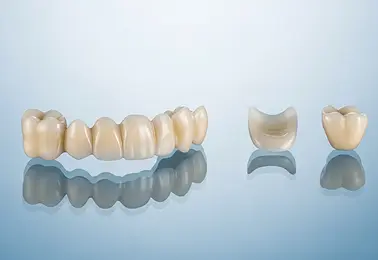
Crowns and bridges
A missing tooth should generally be replaced so that chewing function is preserved and the bite doesn't change further. Crowns and bridges offer a proven solution for this - the bridge is supported by the neighbouring teeth.
Full-ceramic or ceramic-veneered bridges provide a particularly natural-looking, aesthetically convincing dental restoration.
Make an appointment(030) 333 111 90
Send an emailinfo@dr-mustermann.de
Online AppointmentRequest online now
The most important facts at a glance
- A missing tooth should generally be replaced so that chewing function is preserved and the bite doesn't change further.
- A bridge is supported by the neighbouring teeth to close one or more gaps.
- Full-ceramic or ceramic-veneered variants provide a particularly natural-looking result.
Frequently Asked Questions
When does a tooth need a crown?
A crown usually becomes advisable when too much tooth structure is missing to restore the tooth stably with a filling. It encloses the entire visible tooth and thereby restores its function.
Do healthy neighbouring teeth need to be ground down for a dental bridge?
Yes, a classic bridge relies on the neighbouring teeth, which need to be ground down for this purpose. If you want to avoid this, implant-supported tooth replacement can be an alternative, which we will discuss with you.
Does a ceramic crown look like a real tooth?
Fully ceramic or ceramic-veneered crowns come very close to the natural tooth colour and structure and are usually barely distinguishable from your own tooth.