

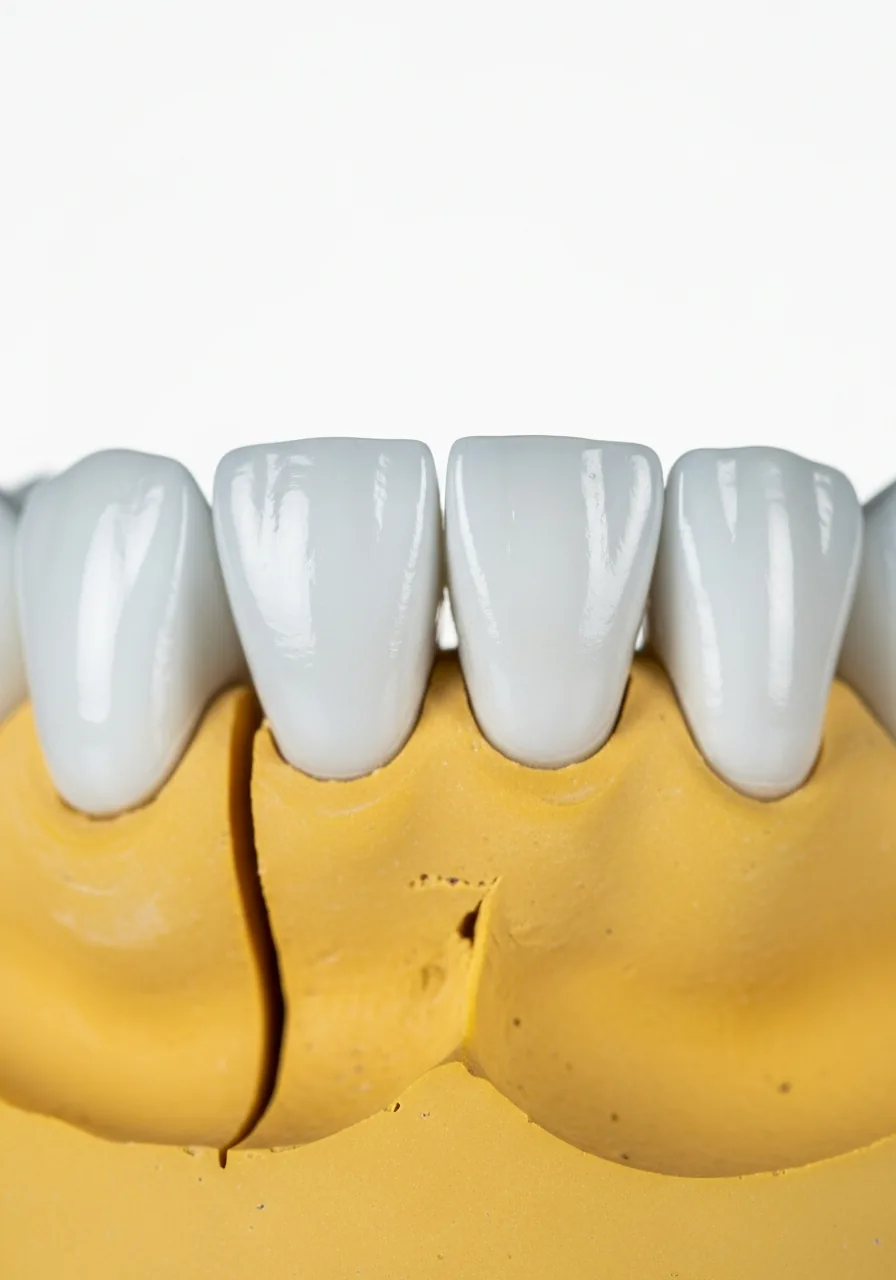
Full ceramics for a natural appearance
Natural teeth create their look not only through shape and colour but also through their translucency - light enters and is reflected in layers. Metal-supported restorations can replicate tooth colour, but can only reproduce this optical effect to a limited extent.
Full-ceramic materials, on the other hand, restore both the colour and the natural translucency - for a result that comes very close to a real tooth.
Das Wichtigste auf einen Blick
- Natürliche Zähne wirken nicht nur durch Form und Farbe, sondern auch durch ihre Lichtdurchlässigkeit (Transluzenz).
- Metallgestützte Restaurationen können die Zahnfarbe nachbilden, den optischen Transluzenz-Effekt aber nur eingeschränkt wiedergeben.
- Vollkeramische Werkstoffe stellen sowohl Farbe als auch natürliche Lichtdurchlässigkeit wieder her, für ein dem echten Zahn nahekommendes Ergebnis.
Frequently Asked Questions
Without the disco effect
To prevent the metal core from showing through, metal-ceramic crowns are first given a white coating layer, the so-called opaquer, before the translucent veneering ceramic is fired on. Long-wavelength light penetrates only slightly into the ceramic and is scattered, while short-wavelength light penetrates deeper and is reflected by the opaquer. As a result, the core area of the crown can glow whitish under intense or short-wavelength lighting - particularly noticeable in nightclubs, where short-wavelength, bluish light is often used as effect lighting, hence the name "disco effect".
This effect does not occur with full-ceramic crowns, since the ceramic itself is translucent and no opaquer is needed.
Without dark margins
Natural tooth structure is translucent: light enters, is scattered within the tooth and reflected in layers. This effect illuminates the tooth neck and gum margin from within - known as natural "back-lighting", which makes the gum margin appear bright. With a metal-ceramic crown, the metal margin usually extends beneath the gum margin. Since light cannot pass through the metal core, this back-lighting effect is lost - the result is the visual impression of dark crown margins.
Translucent full-ceramic crowns do not have this problem: similar to natural tooth structure, light can penetrate right into the core of the crown, so the natural back-lighting effect at the gum margin is preserved.
Feldspar ceramics
Feldspar and glass ceramics are among the oldest ceramics used in dental technology. They stand out for their excellent optical properties, which allow an almost perfect cosmetic replication of natural teeth. Their disadvantage is their comparatively low mechanical strength, which is why they are mainly used as veneering ceramics on crown and bridge frameworks made of metal or zirconia. With adhesive bonding and relatively low expected load, however, they are also suitable for smaller single-tooth restorations - especially where the cosmetic effect is the priority and certain limitations in load-bearing capacity and durability can be accepted in return.
Disilicate ceramics
Disilicate ceramics are among the newest developments in the field of dental ceramics. Their optical and cosmetic properties closely resemble those of feldspar ceramics, yet their strength is roughly three times as high. This makes them usable for all single-tooth restorations as well as smaller and medium-sized bridges. Disilicate ceramics are currently the dental ceramics most frequently used in our practice.
Zirconia
Zirconia is by far the hardest and most durable dental ceramic available to us today. Although zirconia has a certain, albeit low, translucency and looks approximately tooth-coloured, its cosmetic properties fall noticeably short of those of feldspar or disilicate ceramics. Another disadvantage: zirconia cannot be silanised and therefore cannot really be adhesively bonded, since it does not form a chemical bond with luting composites. It is therefore mainly used as a framework material for larger bridges, which are subsequently veneered with feldspar ceramic or layered with disilicate ceramic, as well as for maximally load-bearing single-tooth restorations in cosmetically less critical areas. Zirconia is also used for implant abutments.